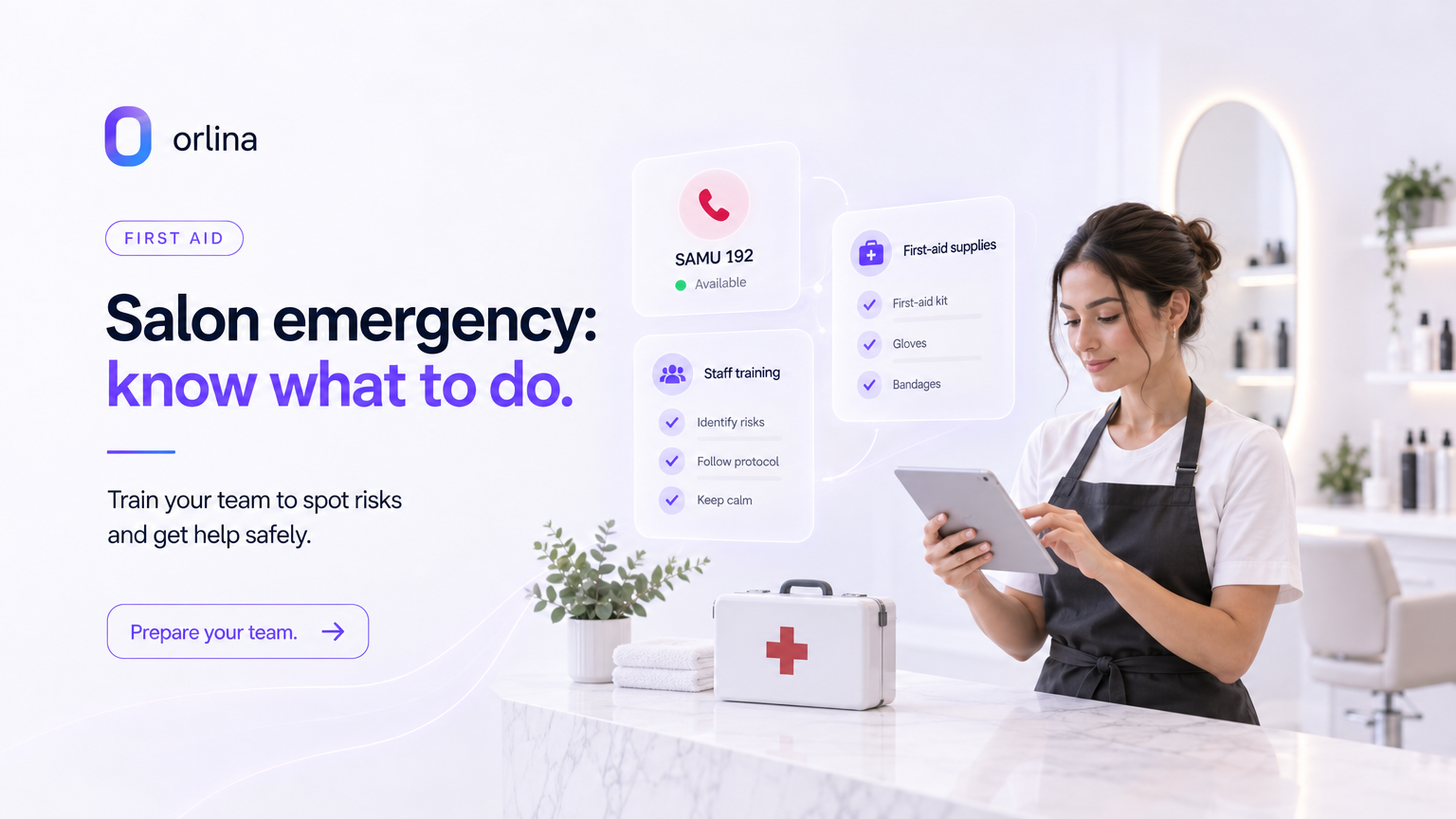
First aid in beauty salons and barbershops consists of the immediate and temporary care provided to a client or employee in the event of an accident or sudden illness. The primary goals are to preserve life and prevent the situation from worsening until professional medical help arrives. According to international workplace safety standards, beauty establishments must maintain a basic first aid kit and a staff trained to identify emergencies such as cuts, burns, or allergic reactions, knowing exactly when to call emergency services (911 in the U.S.).
The Importance of Emergency Preparedness in the Beauty Sector
Working in a salon or barbershop involves the constant use of sharp tools, potent chemicals, heat sources, and electricity. While salon biosafety focuses on infection prevention and hygiene, first aid addresses the response to unforeseen events that can occur even in the most controlled environments.
Being prepared is not just a matter of care; it is an ethical and often legal obligation. Professionals who know how to act in seconds can prevent a superficial cut from becoming a serious hemorrhage or an allergic reaction from evolving into anaphylactic shock. Furthermore, the calm transmitted by the team during an incident preserves the business's reputation and client trust.
Many owners confuse first aid with medical procedures. It is fundamental to understand that the objective here is not to "cure" the client but to stabilize them. You should never offer medication (even a simple pain reliever) or perform invasive procedures. The focus is on basic support and the safety of the scene.
Main Types of Accidents and How to Act
In the daily life of a salon, some incidents are more recurrent due to the nature of the activities. Below, we detail the recommended protocols for the most common situations, respecting the limits of layperson intervention.
1. Cuts and Sharps Injuries
With the use of scissors, razors, and nippers, cuts are the number one accident.
- What to do: Wash your hands quickly, put on disposable gloves, and apply direct pressure to the wound with a clean gauze or dry cloth. Maintain pressure for a few minutes until the bleeding stops.
- What NOT to do: Do not apply substances like coffee grounds, sugar, or ointments without medical guidance. Do not attempt to remove objects that are deeply embedded in the skin.
2. Burns (Thermal and Chemical)
These can occur from using curling irons, flat irons, blow dryers, or contact with chemicals like lighteners and relaxers.
- Thermal burns: Place the affected area under cool running water (never ice cold) for at least 15 minutes to cool the tissue.
- Chemical burns: Rinse thoroughly with running water to remove chemical residue from the skin.
- What NOT to do: Never apply butter, toothpaste, or ice. If blisters form, never pop them.
3. Allergic Reactions and Irritations
Products like dyes and eyelash glues can trigger immediate reactions. It is essential to perform a strand test and patch test before any chemical procedure.
- Warning signs: Intense redness, itching, facial swelling, or difficulty breathing.
- Action: If the client shows difficulty breathing or throat swelling, call 911 immediately. If it is only a local irritation, remove the product with plenty of water and advise the client to see a doctor.
4. Fainting and Drops in Blood Pressure
Ambient heat, prolonged fasting, or the stress of a procedure can cause syncope (fainting).
- What to do: If the client feels like they are going to faint, help them sit or lie down. If they have already fainted, place them on their back with their legs slightly elevated (if there is no suspicion of spinal injury). Check if they are breathing.
- What NOT to do: Do not offer alcohol to smell or splash water on the person's face.
![A professional barber calmly attending to a client who feels dizzy, supporting their arm while another staff member prepares a glass of water, bright modern barbershop setting]
Organizing the First Aid Kit
Every establishment, no matter how small, must have a first aid kit in an easily accessible location. This kit should be reviewed monthly to ensure no items have reached their cosmetic expiration or shelf-life limit.
Below is a comparison between what is needed for routine hygiene and what is specific to the emergency kit:
| Category | Biosafety Items (Routine) | First Aid Items (Emergency) |
|---|---|---|
| Protection | Procedure gloves, Masks | Sterile gloves, Safety goggles |
| Hygiene | 70% Alcohol, Enzymatic detergent | Saline solution (0.9%), Neutral soap |
| Dressings | Cotton, Standard adhesive tape | Sterile gauze, Bandages, Adhesive bandages |
| Support | Paper towels, Disposable sheets | Blunt-tip scissors, Digital thermometer |
| Records | Client intake forms | Notepad for incident reports |
In addition to materials, it is vital to have a contact list posted inside the kit cabinet door:
- Emergency Services: 911 (USA/Canada)
- Poison Control Center: 1-800-222-1222
- Nearest Public Hospital
- Emergency contact phone for each employee
Incident Response Protocol
When an accident happens, the team's reaction defines whether the situation remains controlled or turns into chaos. The workflow should be as follows:
1. Stop the Service Immediately
Do not try to finish the haircut or the dye application. The absolute priority is the person's physical integrity. Turn off electrical appliances and move sharp objects away.
2. Assess the Severity
Check: Is the person conscious? Do they respond to stimuli? Is the bleeding intense? According to the Red Cross, you should call emergency services for chest pain, difficulty breathing, deep burns, or loss of consciousness.
3. Protect the Client's Privacy
An accident can leave a person feeling vulnerable. If possible, use screens or move them to a more private area (if they can move). Prevent other clients from watching or filming, which violates professional ethics and data protection standards regarding client image usage.
4. The Role of the Manager and Team
While one staff member provides basic support, another should be responsible for clearing the area of bystanders and waiting for help at the door. The manager must be informed immediately to provide the necessary logistical support.
![A salon manager organizing a white first aid kit with red cross, checking labels and expiration dates in a clean storage room, soft lighting]
When to Call Emergency Services (911)
Knowing when a situation has exceeded the team's control is a sign of professional maturity. You must call 911 if the client presents:
- Loss of consciousness (even for a few seconds).
- Difficulty breathing or strange breathing sounds.
- Bleeding that does not stop after 10 minutes of firm pressure.
- Burns that cover a large area or cause deep blisters.
- Suspected fractures after a fall.
- Seizures.
When calling, stay calm and provide:
- The exact address with landmarks.
- What happened (e.g., "a client fainted and is not responding").
- The victim's current state.
- Do not hang up until the operator authorizes it.
Incident Recording and Post-Emergency
After the immediate danger has passed, the work is not over. It is fundamental to record the occurrence for legal purposes and internal improvement. Document:
- Client name, date, and time.
- The procedure that was being performed.
- Detailed description of the accident.
- Initial measures taken by the team.
- The client's destination (e.g., home or hospital).
This record serves as a basis for reviewing processes. If the accident was a cut, do the scissors need maintenance? If it was a fall, was the floor wet? Efficient management, supported by tools like a digital scheduling system, helps identify if the client had pre-existing conditions or allergies previously reported.
Establishment Preparedness Checklist
To ensure your salon or barbershop is safe, follow this practical checklist:
- First Aid Kit: Located in a visible, signaled, and easily accessible place.
- Staff Training: At least one basic annual training for all employees (including receptionists).
- Emergency Phones: Printed list posted near the landline and in the kit.
- Updated Client Files: Emergency contact phones registered in the online scheduling system.
- Emergency Lighting: Working perfectly for power outages during procedures.
- Fire Extinguishers: Within the expiration date and with staff trained for use.
- Non-Slip Flooring: Maintenance of wet areas (shampoo bowls) to prevent falls.
Technology at the Service of Safety
An organized environment drastically reduces the risk of accidents. When the schedule is chaotic, the professional works in a rush, which is the perfect trigger for cuts and chemical dosage errors. Using a system like Orlina allows the professional to have the necessary time between appointments, ensuring that cleaning and room preparation are done without rushing.
Furthermore, Gabriel, Orlina's AI assistant (available on Pro plans and above), helps keep the client informed about pre-procedure protocols. For example, if a client is booked for coloring, Gabriel can reinforce the importance of arriving early for an allergy test. This proactive communication is an extra layer of security for your business.
With Orlina, you can start free for your first 10 appointments and then choose the plan that best fits your reality, from Starter at $9/month to Infinity at $99/month. Digital management is not just about profit; it is about having total control over your workspace.
![A tablet on a salon counter displaying a digital health questionnaire for a client, with a professional aesthetician in the background, soft professional atmosphere]
Limits of Action and Professional Ethics
It is imperative to reinforce: barbers, hairdressers, and aestheticians are not doctors. First aid actions must be strictly limited to basic life support and comfort.
- Never apply eye drops if a product falls into the eyes; use only saline or running water.
- Never offer water or food to someone who is unconscious or has just fainted (choking risk).
- Never try to "pop back" a bone that looks dislocated.
Respecting these limits protects you legally and ensures the client receives proper treatment from those with the technical competence to intervene. According to international labor safety guidelines, compliance with health regulations and risk preparation are pillars of any beauty business's sustainability.
Managing the Schedule After an Accident
If an emergency occurs, your day's schedule will be affected. In these moments, automation is your greatest ally. If you use Orlina, you can use the time blocking feature to close the rest of the day while you resolve the situation.
On Pro plans ($49/month) and above, Gabriel can even assist in communicating with the next clients, explaining that an unforeseen event occurred and suggesting a reschedule. This prevents other clients from arriving at the salon and finding a tense environment, preserving your business image even in the middle of a crisis.
Conclusion
Preparing your team for first aid in beauty salons and barbershops is an investment in safety, ethics, and professionalism. Accidents happen, but how we react to them defines the future of our careers and our establishments. Keep your kit updated, your team trained, and use management tools that allow for a calm and organized workflow.
Remember: in case of doubt or severity, 911 is your best ally. Protect your clients, protect your team, and maintain excellence in service, ensuring that beauty never comes at the expense of health.
Frequently asked questions
Can I give a pain reliever if a client gets hurt in the salon?
No, beauty professionals should not administer any type of medication, even over-the-counter ones like ibuprofen or aspirin. This can cause severe allergic reactions or mask symptoms of more serious problems. The professional's role is strictly to provide basic support and superficial dressings.
What should I do if bleach gets into a client's eye?
The first step is to flush the eye with plenty of running water or saline solution for at least 15 minutes, keeping the eyelid open. Do not attempt to use eye drops or neutralizing substances. After the initial wash, direct the client immediately to an ophthalmologist and provide the packaging of the product used.
Is it mandatory to have a first aid kit in the salon?
While specific laws vary by region and state, most workplace safety regulations (such as OSHA in the US) require commercial establishments to have basic materials for emergency care. Beyond legal requirements, it is an essential practice for biosafety and the owner's civil liability.
How should I act if a client has a seizure in the chair?
Do not try to restrain the person or put anything in their mouth. Move nearby objects away so they do not get hurt, place something soft under their head, and time the duration of the seizure. Once the seizure ends, place the person on their side in the recovery position. If the seizure lasts more than 5 minutes or is their first one, call 911.
Does professional liability insurance cover first aid accidents?
Generally, professional liability insurance covers damages caused to third parties during the provision of service, which can include medical costs resulting from accidents. However, coverage depends on the specific policy and whether the establishment followed the safety and biosafety standards required by law.