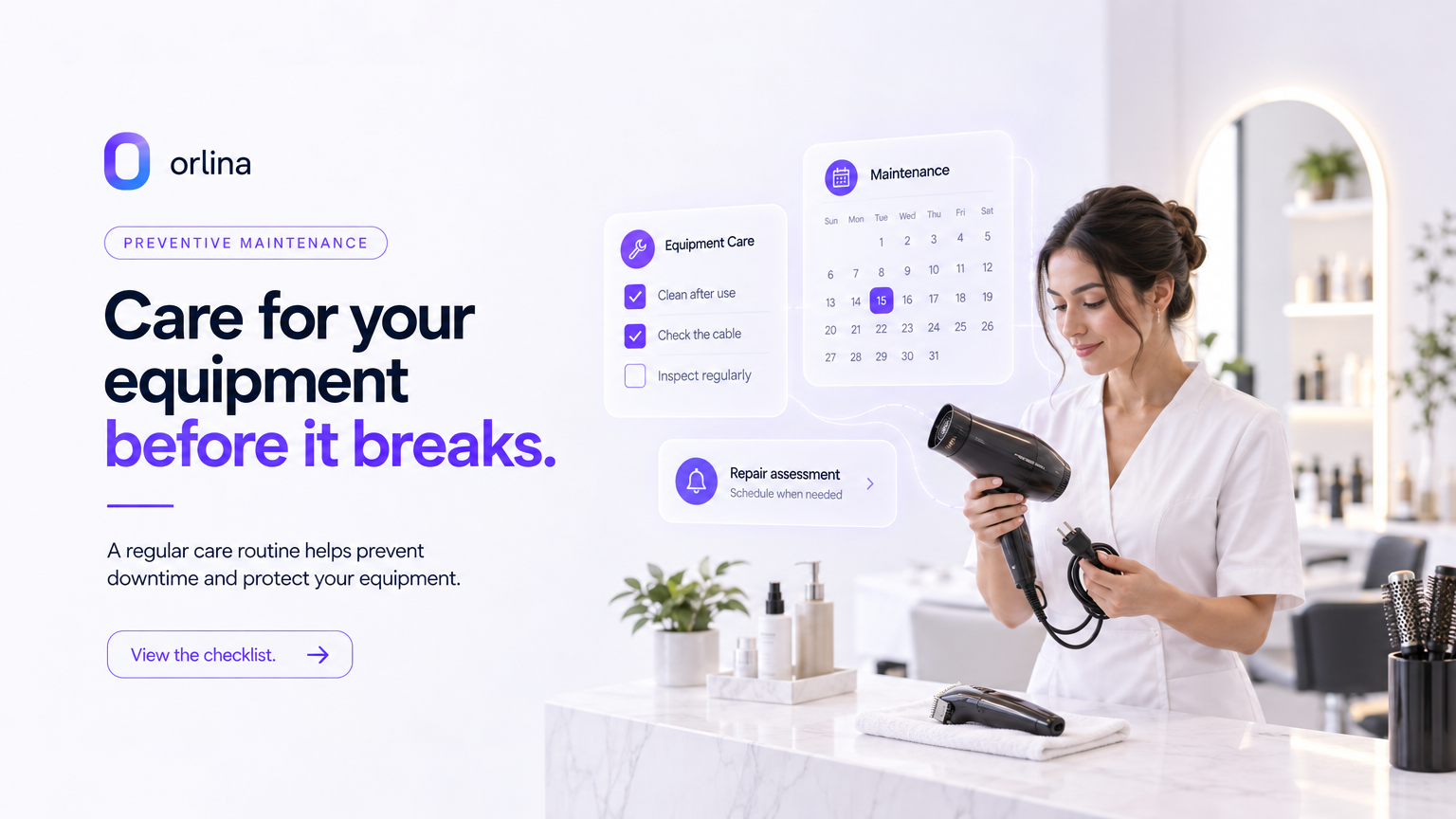
Maintaining your salon or barbershop equipment is not just about cleanliness; it is a critical business strategy to prevent service interruptions and extend the lifespan of your professional tools. By implementing regular routines for cleaning, lubricating, and inspecting dryers, clippers, and flat irons, you reduce unexpected replacement costs and ensure client safety. According to industry safety standards, proactive tool care is a cornerstone of operational efficiency for any service-based entrepreneur.
For a solo professional or a salon owner, your equipment is your primary means of generating income. A hair clipper that jams in the middle of a fade or a hair dryer that burns out during a blowout doesn't just represent a repair cost—it represents immediate lost revenue and potential damage to your professional reputation. Managing a successful business involves more than just an online scheduling system; it requires technical care for the physical assets of your company.
The Importance of Preventive Maintenance in Professional Daily Life
Preventive maintenance is not simply cleaning equipment when it looks dirty. It is a risk management strategy. In a salon or barbershop environment, devices are subjected to extreme conditions: intense heat, chemical product residues, accumulation of fine hair, and continuous use for several hours straight.
Maintaining equipment is also a matter of biosafety and electrical safety. A worn cable or an overheating motor can cause short circuits, risking the physical integrity of both the professional and the client. Furthermore, well-maintained equipment consumes less electricity, which directly impacts your monthly profitability. According to the Occupational Safety and Health Administration (OSHA), regular inspection of electrical tools in a workplace is vital to prevent fire hazards and electrical shocks.
By adopting a proactive stance, the professional stops "putting out fires" and gains total control over their tools. This reflects in the quality of service: sharp, clean blades cut better, reduce execution time, and prevent skin irritation for the client. Dryers with unobstructed filters dry hair faster and with less noise.
Professional Hair Dryers: The Heart of the Station
The hair dryer is perhaps the item that suffers most from intense use. It vacuums air from the environment to heat it and expel it at high speed. The problem is that along with the air, the device sucks in dust, suspended hair, and particles of finishing sprays.
Cleaning the Rear Filter
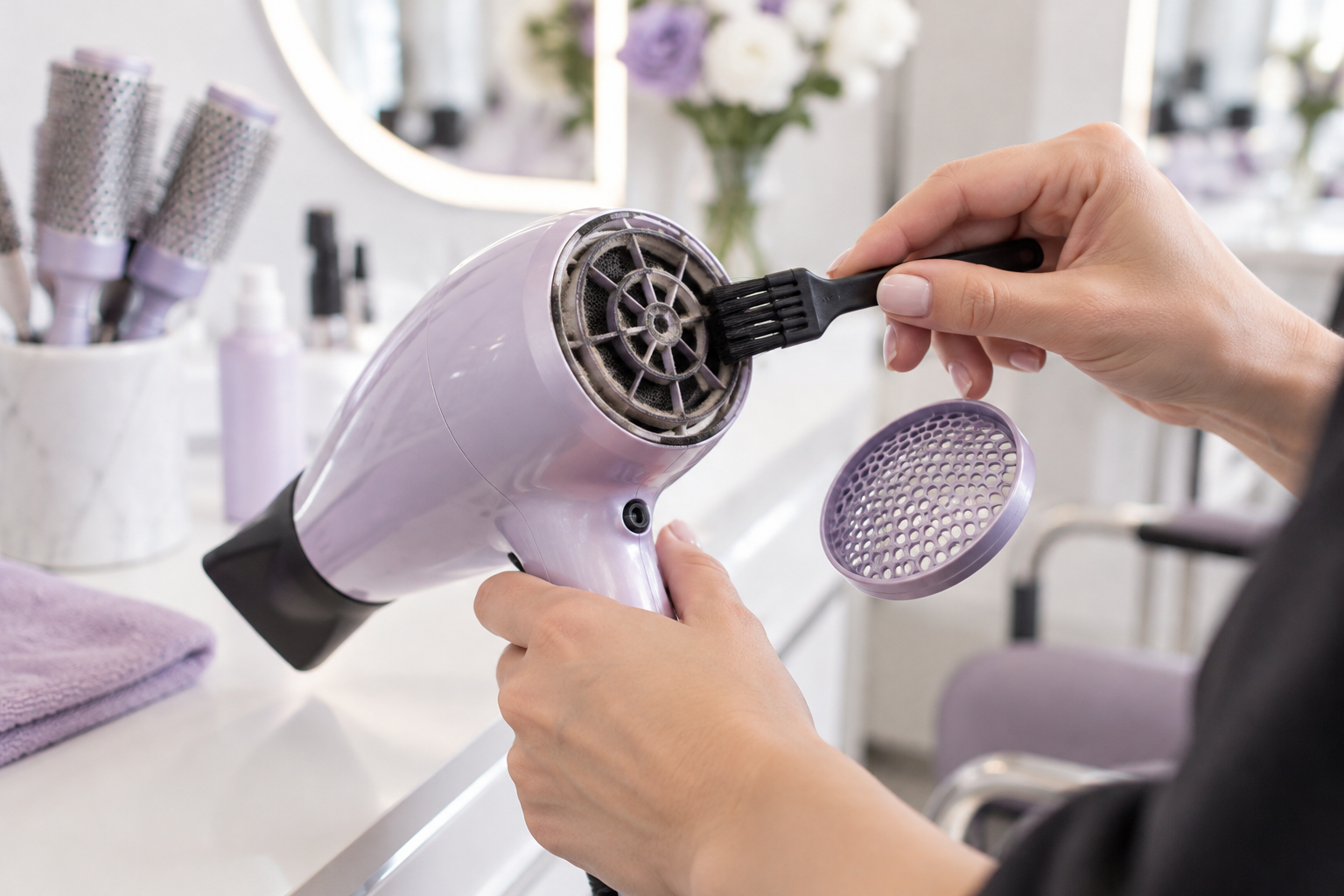
The most basic and mandatory maintenance is cleaning the rear filter. Most professional models have a removable grill. If this grill is obstructed, the motor must work much harder to pull air, which causes overheating.
- Frequency: Daily or every two heavy blowout sessions.
- How to do it: Remove the grill and use a soft-bristled brush or a paintbrush to remove all fiber and dust buildup. Never wash the filter and put it back damp; moisture can damage the internal motor.
Power Cord Inspection
The constant movement of rotating the dryer around the client's head causes twists in the cord. Over time, internal wires can break, even if the outer rubber looks intact.
- Warning sign: If the dryer turns off by itself when you tilt your arm in a certain position, the cord has a faulty connection. Stop use immediately. Continued use under these conditions can generate sparks and melt the plug.
When to Replace a Professional Dryer?
Many professionals wonder when it's time to retire equipment. A high-quality professional dryer can last years, but if the motor noise changes drastically (metallic sounds or excessive high-pitched whines) or if it starts to smell like burning even after cleaning the filter, the motor brushes or the heating element may be at the end of their lifespan.
Hair Clippers and Trimmers: Precision and Hygiene
Unlike a dryer, a clipper deals with direct mechanical friction between metal blades. Without lubrication, the metal heats up, loses its edge, and "tugs" at the client's hair, causing discomfort.
Cleaning and Lubrication
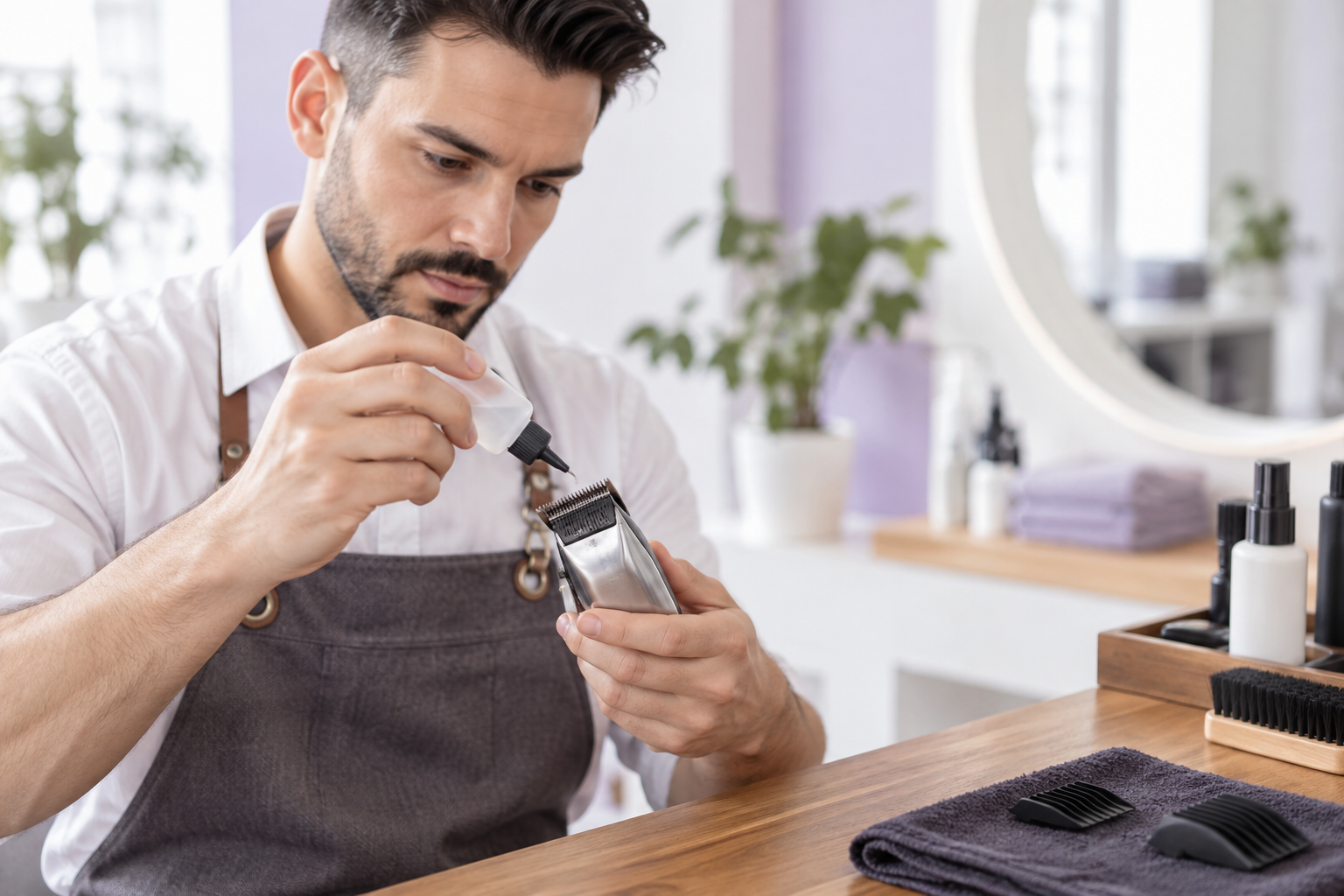
After each cut, it is essential to remove the hair that stays between the blade teeth. The accumulation of strands prevents the blade from sliding smoothly.
- Step 1: Use a cleaning brush to remove visible hair.
- Step 2: Apply a specific lubricating oil for clippers. Just two or three drops are enough. Turn the machine on for a few seconds so the oil distributes uniformly and wipe off the excess with a dry cloth.
- Tip: Using cooling sprays (coolants) is excellent during the workday, but they do not replace lubricating oil at the end of the day.
Blade Alignment
Misaligned blades can cut the client's skin. Periodically check if the moving blade is parallel to the fixed blade and if there are no broken teeth. If the machine fell on the floor, the probability of the blades being out of place is high. Don't try to force alignment without the correct tools; often, slightly loosening the rear screws, adjusting, and retightening solves the problem.
Battery Care (Cordless Models)
For cordless machines, the health of the lithium battery is vital. Avoid letting the battery drain completely. Ideally, keep the charge between 20% and 80% whenever possible. If the machine is to be stored for a long time, leave it with a half-charge.
Flat Irons and Stylers: Caring for the Surface
Flat irons accumulate residues of heat protectants, finishers, and keratin. This "gunk" carbonizes with heat, creating a rough layer that prevents a smooth glide through the hair, potentially causing breakage due to traction.
- Cleaning: With the device turned off and only slightly warm (almost cold), wipe with a microfiber cloth lightly dampened with water or isopropyl alcohol (check the manufacturer's manual). Never use abrasive sponges or knives to scrape residues, as this damages the ceramic or titanium coating.
- Storage: Never wrap the cord around a hot flat iron. This melts the wire insulation and shortens the device's life. Wait for it to cool down completely before storing.
Preventive Maintenance Checklist
To facilitate the organization of your salon or barbershop, use the table below as a quick reference guide for your care routines.
| Equipment | Required Action | Frequency | Objective |
|---|---|---|---|
| Hair Dryer | Air filter cleaning | Daily | Prevent motor overheating |
| Clippers | Blade lubrication | Every 2-3 uses | Reduce friction and maintain edge |
| Clippers | Deep sanitization | Daily (End of day) | Biosafety and residue removal |
| Flat Irons | Plate cleaning | Weekly | Ensure glide and hair shine |
| Shampoo Bowls | Drain/Trap cleaning | Weekly | Prevent clogs and bad odors |
| Scissors | Screw adjustment & oil | Weekly | Cutting precision and ergonomics |
Maintaining this control is as important as knowing how much time is lost in repetitive tasks. Management automation frees up time so these technical cares can be performed without haste.
Red Flags: When to Stop Use Immediately
Some problems cannot be ignored without the risk of a serious accident. If your equipment presents any of the signs below, unplug it and send it to an authorized technical service:
- Ozone or burning smell: Indicates that internal electrical components are melting or short-circuiting.
- Visible sparks: Common in dryers when motor brushes wear out, but dangerous if coming from the power cord.
- Loose parts noise: If shaking the device reveals something loose inside, do not turn it on. It could be a piece of plastic or metal that will cause a catastrophic jam.
- Cord hot to the touch: If the power wire gets excessively hot during use, the internal wiring is undersized or damaged.
- Small shocks: If touching the metal part of a machine or the dryer body gives you a "tingling" sensation, there is a current leak.
According to business sustainability principles, correct maintenance of assets is a pillar for the financial health of small businesses. Ignoring these signs can lead to a much larger loss than the cost of a simple repair.
Technical Assistance vs. DIY Repair
A common mistake among professionals is trying to open devices for electrical repairs. Professional equipment has warranty seals and complex temperature sensor configurations.
- What you can do: External cleaning, blade lubrication, external filter replacement, and basic blade alignment (per manual).
- What you should NOT do: Open the dryer casing, try to splice power cords with electrical tape, replace heating elements, or mess with the electronic board of cordless machines.
Remember that a poorly done repair can void safety certifications and cause fires. Always seek services authorized by the brand (such as Wahl, Andis, Parlux, etc.).
Deciding Between Repair or Replacement
There comes a moment when investing in a repair is no longer worth it. To make this decision, consider the 50% rule: if the repair quote is more than 50% of the cost of new equipment, replacement is usually more advantageous.
Also, consider technology. An old dryer may be much heavier and noisier than current models, affecting your ergonomics at work. New equipment is usually more energy-efficient, which pays for itself in the long run on the electricity bill.
Organizing Your Schedule for Maintenance
One of the greatest challenges for a solo professional is finding time to care for tools. The routine is usually busy, and often the time between one client and another is only used for superficial cleaning.
To solve this, you can use time blocking in your schedule. Reserve, for example, the last 30 minutes of every Friday for "General Maintenance." During this period, you clean all flat irons, lubricate all machines, and check dryer filters.
If you use the Orlina scheduling system, you can set up these recurring blocks so that no client books a time during your asset care moment. Having tools in order is the first step to ensuring that when Gabriel confirms an appointment for you, the execution of the service is impeccable.
Biosafety and Equipment
Preventive maintenance is also linked to public health. Clippers accumulate dead skin cells and minimal body fluids. Cleaning with disinfectant sprays is fundamental. For nail technicians, maintaining the autoclave is even more critical. Always check the sealing gaskets and perform weekly biological tests to ensure sterilization is actually occurring. For more details on this topic, see our manicure nipper sterilization guide.
The Financial Impact of Neglect
Imagine this scenario: you have a busy Saturday with 10 cuts scheduled. Your main clipper jams during the second appointment due to lack of lubrication. You don't have a backup and have to run out to buy a new one at a retail store (paying more) or try an emergency repair. The cost of the forced "no-show" of your clients, combined with the stress and the value of the new machine, is massive.
Preventive maintenance costs cents (the price of oil and a few minutes of your time) and saves hundreds of dollars. It is an essential part of your financial planning.
Summary of the Ideal Routine
To keep things in order, we suggest the following division of tasks:
-
Daily:
- Clean hair dryer filters.
- Remove hair and lubricate clipper blades.
- Clean combs and brushes (remove strands).
-
Weekly:
- Sanitize flat iron and styler plates.
- Check power cord integrity.
- Clean shampoo bowl drains to prevent backflow.
-
Monthly:
- Check clipper blade alignment.
- Deep clean chairs and lubricate hydraulic systems (if applicable).
- Test all plugs and outlets for heating.
-
Every Six Months:
- Technical service review for high-intensity equipment (like autoclaves and primary dryers).
Conclusion
Caring for your equipment is caring for your career. A professional who respects their tools demonstrates professionalism and care, something clients perceive and value. By combining technical care with modern management—using tools like Orlina to organize your service schedule—you create a solid base for your business growth.
Do not wait for equipment to stop to give it attention. Prevention is the cheapest and smartest path to success in beauty and aesthetics.
Frequently Asked Questions
Can I use cooking oil to lubricate my hair clippers?
No, you should never use cooking oil or common multi-purpose oils (like WD-40) to lubricate clipper blades. Cooking oil oxidizes and becomes a sort of glue with heat, jamming the motor. Use only thin mineral oils specific for clippers, which withstand high temperatures without losing viscosity.
The dryer is making a strange noise, but it still blows hot air. Can I keep using it?
It is not recommended. A different noise (whistling, metallic banging, or excessive vibration) usually indicates that the motor bearing is failing or that something has entered the fan. Continued use can lead to total motor failure or even the detachment of internal parts that could be expelled through the nozzle.
How do I know if the hair dryer cord is damaged internally?
The clearest sign is intermittency: the device turns on and off as you move the cord. Another sign is excessive heating of a specific part of the wire or the presence of permanent "kinks" that won't straighten. In these cases, the cord must be replaced entirely by a qualified technician.
How often should I send my dryer for a technical review?
For intense professional use (more than 5 blowouts daily), a preventive review every 6 to 12 months is recommended. The technician will perform internal motor cleaning, replace carbon brushes (if necessary), and check the heating element integrity, preventing the device from burning out during an appointment.
Should flat iron cleaning be done while they are on or off?
Cleaning should be done with the device unplugged and slightly warm. If it is too hot, the cleaning product (or even water from the cloth) can evaporate abruptly and cause steam burns or thermal shock to the ceramic plates, causing cracks. Never submerge the device in water.